Dee Estuary Birding
Monthly Newsletter...
November 2026
Newsletter

Sandwich Terns
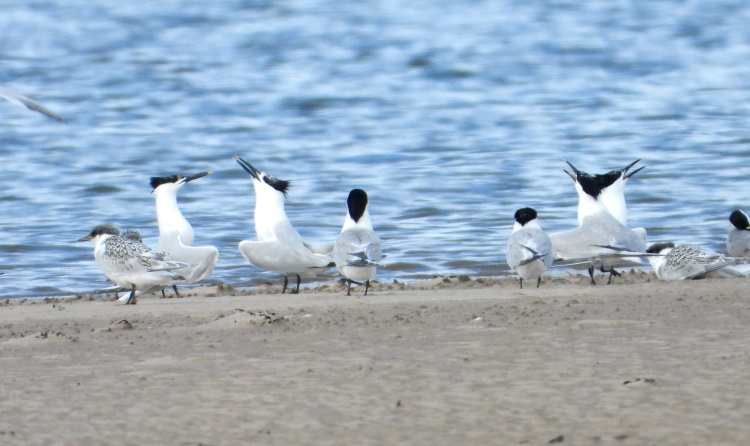
Just me and 400 Sandwich Terns. Fantastic! So much noise, so much activity. Birds flying in with fish in their beaks whilst the juveniles are begging for food. Despite it being the post-breeding season there is a surprising amount of display with adults strutting around with beaks in the air. Then there are the colour ringed birds. I look at Orange KPD with some awe knowing it was seen on Greenways Beach, Cape Town, last November - seven and a half thousand miles* away! Red NAX breeds in a colony near Rotterdam and must have flown across the country to get here. Yellow CO2 I'm particularly pleased to see as I saw it as a young juvenile in 2021, I saw it again in 2024 and here it is near Hilbre in 2026. I think it has a young bird of it's own now but it's difficult to tell with the birds all milling around.
That was my visit out to the sand bank near Middle
Eye in late July this year and I hope gives an idea of what motivates
me to walk out there.
We only see Sandwich Terns here on passage, when they are either on the way to the breeding colonies in Spring or after breeding when the Dee Estuary, and the surrounding coastline around Liverpool Bay, act as a staging area for several weeks before they head south for the winter. Colour ringing demonstrates that we get Sandwich Terns here which have bred in colonies all over the British Isles, and also the Netherlands, but most come from the Irish Sea colonies, of which Cemlyn Bay, just over 50 miles away on the northern tip of Anglesey, is the nearest.
* The straight
line distance from the Dee Estuary to Cape Town is just over 6,000
miles, but the Sandwich Terns have to fly around the bulge of west
Africa which means they fly at least 7,500 miles.
Cemlyn Bay, Anglesey
The table below is a summary of the history of the
Cemlyn Bay colony over the past 30 years.
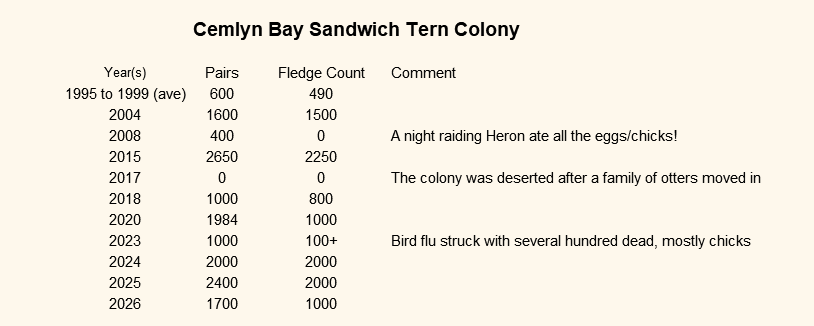
After a period of stability and good productivity, but with counts a lot lower than today, numbers started to increase at the beginning of this century. There have been many good years since, as well as a few disasters! The night visiting Grey Heron first started predating the colony in 2007 and it took a while for the wardens to work out what the problem was. Eventually they used green lasers to scare the bird away, and numbers recovered such that by 2015 there were record numbers of both pairs and fledglings.
The colony was completely deserted in 2017 when a
family of otters arrived. This happened around mid-June and several
colonies around the Irish Sea saw the late arrival of terns due to
Cemlyn birds relocating. This included an
influx of 250 pairs at Hodbarrow on 25th June which coincided with the
final abandonment at Cemlyn just a few days before. These late birds
established a
discrete sub-colony at Hodbarrow that hatched 175 chicks, the majority
of which fledged.
2018 saw a lot more movement between Cemlyn Bay and Hodbarrow, in both directions, and it resulted in a peak count of 1950 pairs at Hodbarrow which is way above the 'normal' count of 300 to 500 pairs (see next section).
Numbers at Cemlyn Bay had recovered by 2020 only for the colony to be struck by Bird flu in 2023. Several hundred Sandwich Terns died but these were mostly chicks and the good survival of breeding adults meant that numbers were able to recover quickly, with 2025 being a particularly good season.
Hodbarrow (Cumbria)
Hodbarrow RSPB is about 55 miles to the north of the
Dee Estuary and
is home to our next nearest breeding colony, and below is a summary of
the history of the colony since 1997.
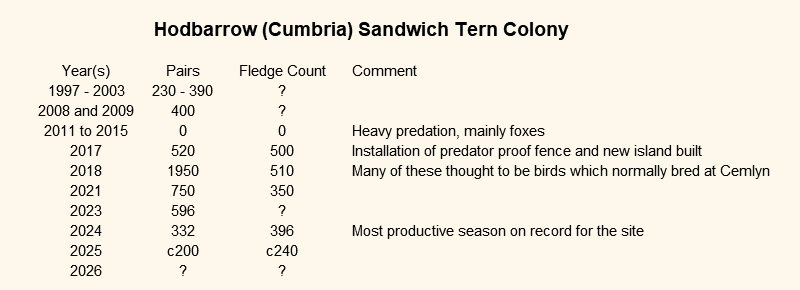
Although I've not found any fledgling counts for the early part of this century the numbers of pairs counted indicate that it was a period of stability with between 200 and 400 pairs regularly breeding, then disaster struck! Sandwich Terns continued to arrive each spring but heavy predation by foxes meant that no pairs bred for five years. But in 2016 predator proof fencing was installed and by 2017 520 pairs were breeding and successfully raised 500 young, a fantastic result. 2017 and 2018 coincided with problems with a family of otters at Cemlyn Bay and no doubt many of unprecedented 1950 pairs that turned up at Hodbarrow in 2018 came from there. These large numbers caused much over-crowding and many of the terns weren't able to settle down and nest, so halfway through the season 500 pairs left and returned to Cemlyn, much to the surprise of the wardens there.
Since then numbers have dropped but 2024 and 2025 saw excellent productivity (number of fledglings per nest), good news for this population whilst they recover from bird flu. I don't yet have any numbers for 2026 from Hodbarrow but I wouldn't be surprised if the drop in numbers at Cemlyn this year coincided with an increase at Hodbarrow.

West Kirby Shore July 2022 © Richard Smith
2026 Breeding Season Elsewhere in the UK
With Sandwich Terns recovering well from Bird Flu they seem to have had a good breeding season in 2026. I don't have a full picture of all the colonies but here is a selection of some good news stories.
Blakeney Point,
Norfolk.
After a two year absence 1,164 pairs of Sandwich Terns returned to
Blakeney Point in 2026 and successfully fledged 700 young.
Pagham Harbour
RSPB, West Sussex.
A record number of 756 pairs bred in 2026. A remarkable turnaround
after the colony was abandoned in 2022 when Bird Flu struck.
Sands of Forvie,
North-east Scotland.
A record number of chicks were ringed by the Grampian Ringing Group,
including over 1,000 Sandwich Terns.
Colour Rings
Each year, a handful of dedicated colour-ring readers along the coast of Liverpool Bay record the identities of Sandwich Terns resting and feeding here. By reporting these sightings, we contribute to a much bigger picture of the movements of individual birds, linking breeding colonies around the Irish Sea and elsewhere with wintering grounds thousands of miles away in Africa. Colour ringing has transformed our understanding of their movements, revealing journeys and connections that would otherwise remain largely hidden. Here are just a few examples of the life histories that these rings have helped uncover.
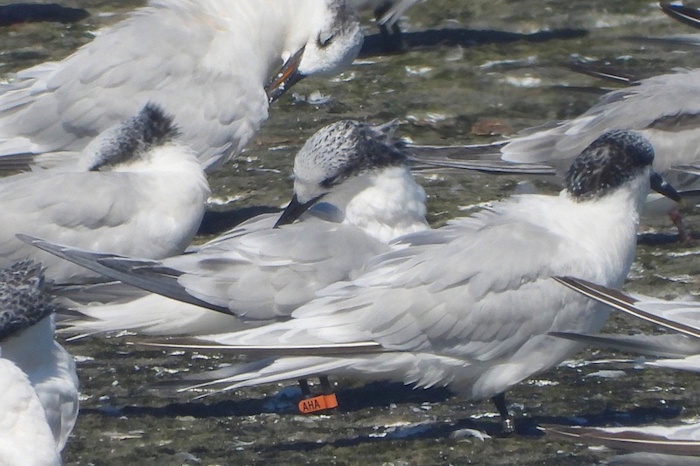
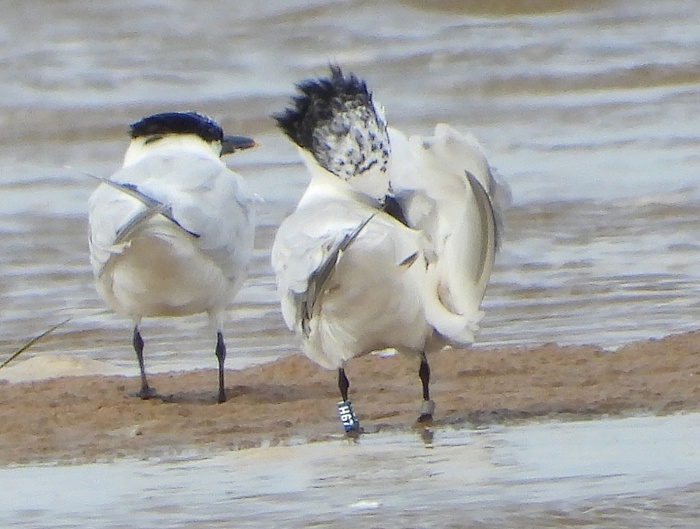
(photo kindly provided by Steve Dodd - SCAN Ringing Group)
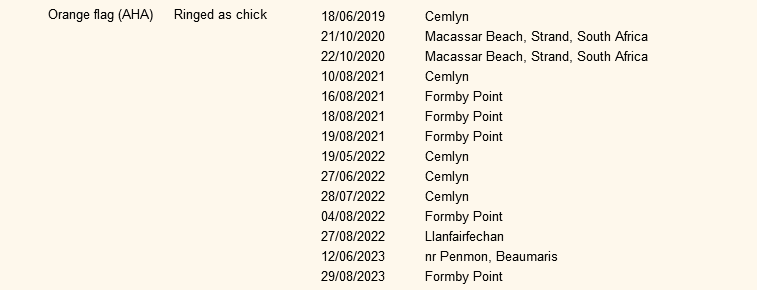
They didn't start colour ringing at Cemlyn Bay until
2019 so this was one
of the first ones ringed. As a young bird it made it all the way to
Cape Town in 2020 before returning to breed back at Cemlyn Bay as an
adult.
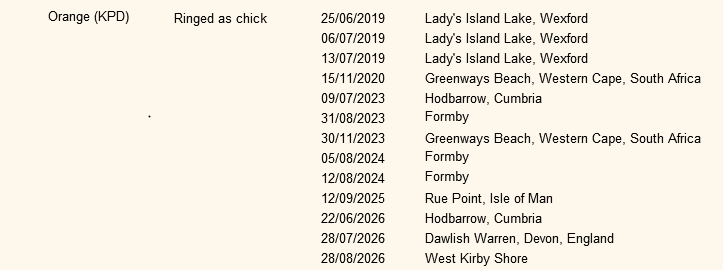
Hatched in the largest colony in Ireland this was another young bird which reached Capre Town. It has since returned to breed at Hodbarrow, note the movement south to Dawlish Warren and back to West Kirby this summer - perhaps it was a failed breeder?
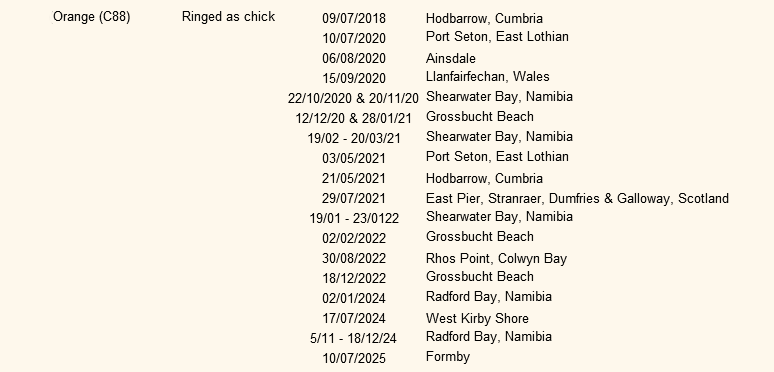
This one visits Namibia every winter (their summer).
Colour ringing strongly suggests that a good proportion of the
north-west European population of Sandwich Terns make it all the way to
Namibia and South Africa - a flying distance of at least 7,500 miles,
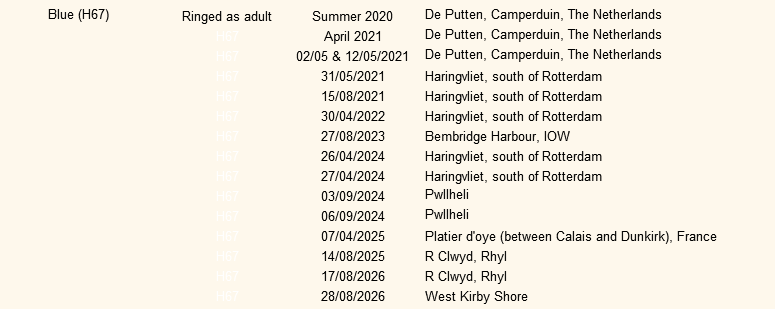
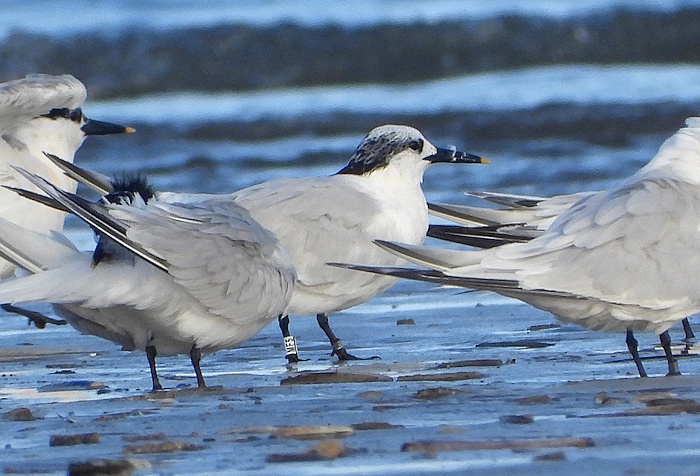
A Dutch ringed bird which bred in the north of the
Netherlands in 2020 but seems to have moved further south in recent
years. Since 2024 it has flown westwards across the British mainland
each year after breeding to reach the Irish Sea.

Hatched on Coquet island and now a regular breeder there. There is a bird observatory at Kartong, Gambia, and plenty of British birders visit the country so we get quite a few records from there.
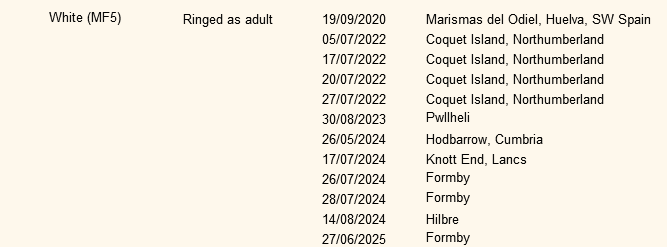
A few Sandwich Terns get ringed on passage including this one which was ringed near the Portuguese border in south-west Spain. Despite several records at Coquet Island in July 2022 there was no proof it bred there, but it does appear to have bred at Hodbarrow in 2024.

Sources of Information
The North Wales Wildlife Trust have a Cemlyn Bay
blog, updated
monthly during the tern breeding season, and this provided a wealth of
information about the Sandwich Terns -
https://www.northwaleswildlifetrust.org.uk/cemlyn-terns#archive.
In 2018 the North Wales Wildlife Trust, with the assistance of the
National Trust and RSPB, wrote a written representation "Biodiversity
- Cemlyn Nature Reserve" detailing their concern about the proposed
Wyfla Newydd Nuclear Power Station and this contained a lot of details
about the history of the Cemlyn Bay colony up to 2018.
For Hodbarrow there was some useful historical data in "Bird News"
published by the Cumbria Bird Club in 2013. More up to date numbers
were found in various blogs published by the RSPB and the "Life on the
Edge" Project including:
https://www.projectlote.life/news/category/sandwich-terns
The life histories of the colour ringed Sandwich Terns was provided by
the various ringing groups - with special thanks to Stephen Dodd at
Cemlyn Bay, Bart Donanto at Hodbarrow and Tony Murray at Lady's Island
Lake, Wexford.
The records themselves are made by enthusiasts like myself including
Sean O'Hara and Tony Ormond on the Dee Estuary/North wirral, Alex Jones
(and the 'North Wales Team')
along the North Wales coast and Tim Vaughan and Peter Knight on the
Sefton Coast.
Richard Smith
Colour Ring Report
Cormorant
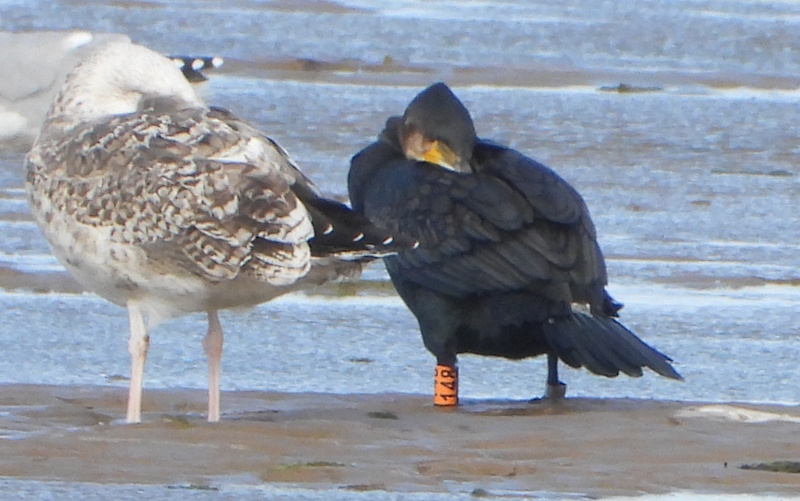
O(148)
Ringed at Hale Duck Decoy in June 2022 as a chick.
This one is a regular at Hoylake and Seaforth, the latest records being
at Hoylake on 09/10/26 and 27/10/26.
It returned to Hale Duck Decoy to breed in 2025 and 2026.
Shelduck
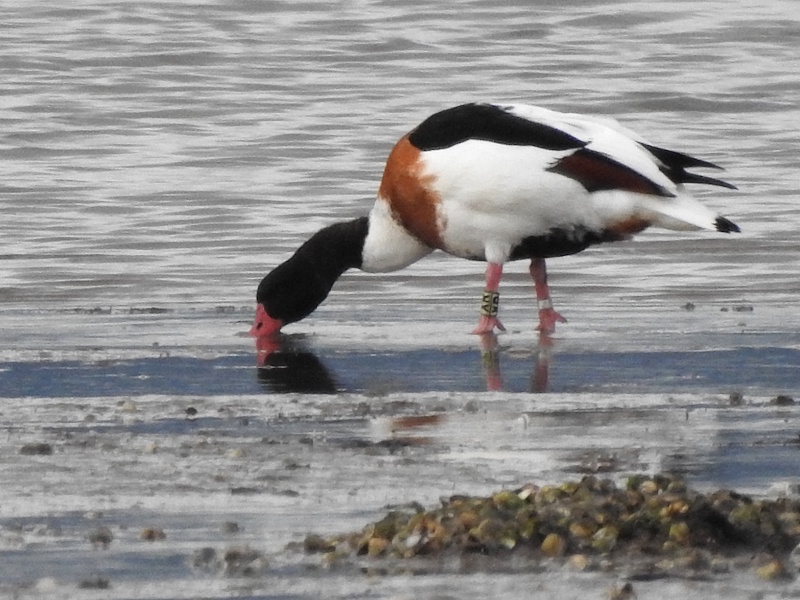
Lime (XR)
Ringed at WWT Martin Mere on 19/11/2018 as an adult.
Recorded on Thurstaston Shore on 21/10/2026.
Lime (XR) is typically seen on Thurstaston Shore during September and
October before moving to WWT Martin Mere (Lancs) where it has been
recorded every year during November and December. There are no records
for any other month so we can only guess where it spends the rest of
the year, including the breeding season.
Curlew Sandpiper
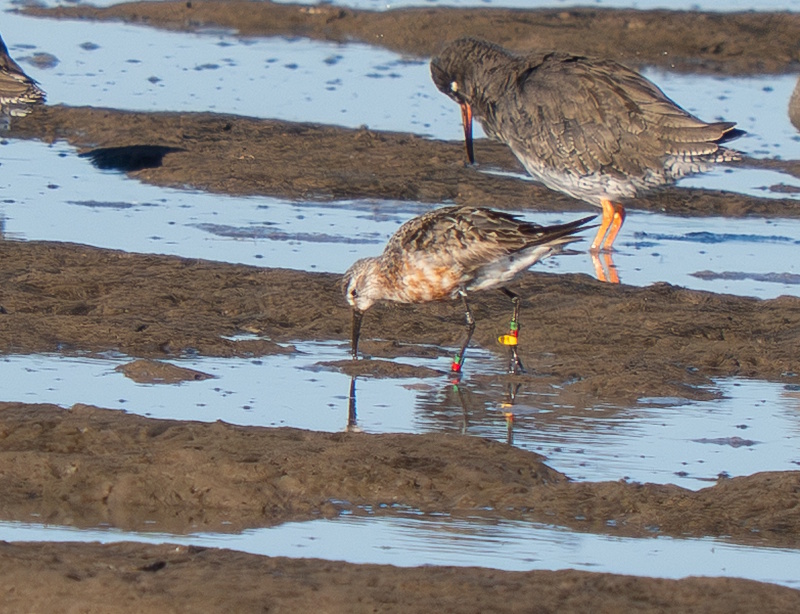
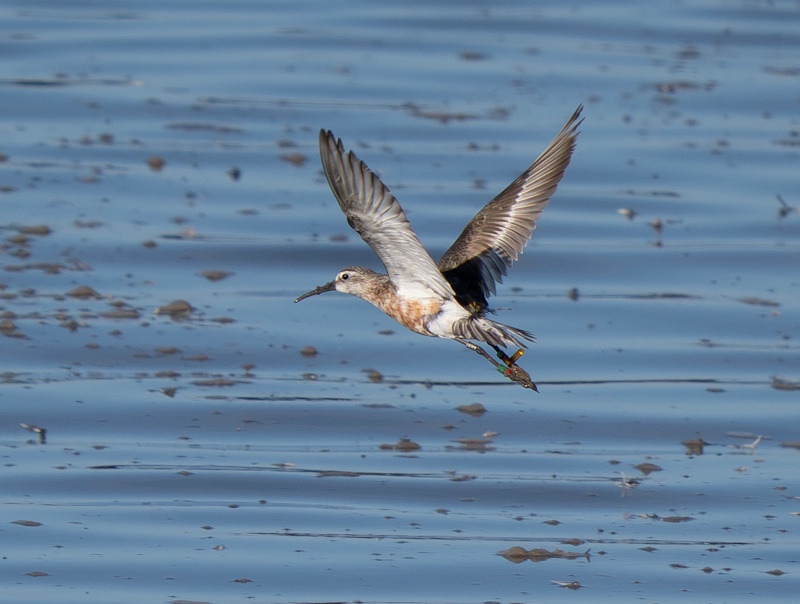
GR-GRYflag
Ringed on the island of Griend, Dutch Waddensea, on 27/07/2025 as an adult.
Recorded on the southern coast of Brittany, near Locmiquelic, on 12/08/2025.
It was on Flint Marsh on 03/10/2026.
Undoubtedly the colour-ringed bird of the month. The
only other ringed Curlew Sandpiper we've had was 10 years ago, a
juvenile ringed in Norway.
Quite what an adult Curlew Sandpiper was doing in the Dee Estuary in October I have no idea, they should all be in Africa!
Redshank
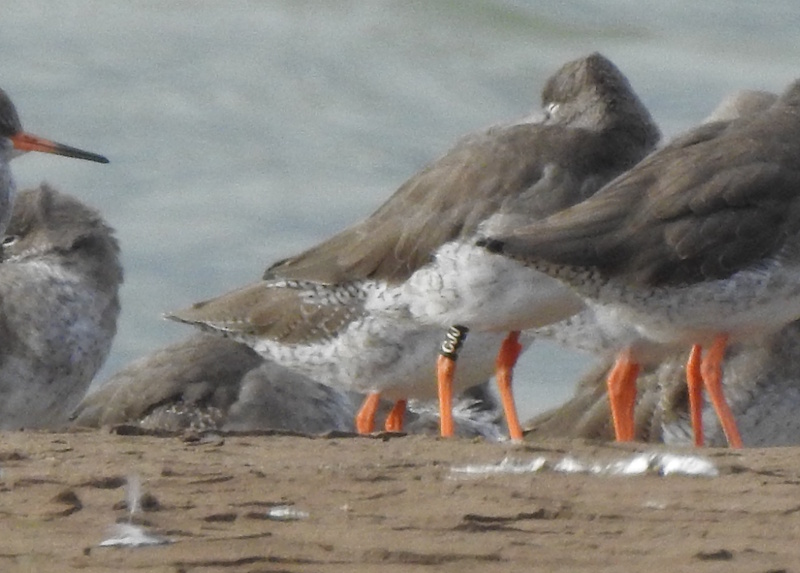
O - N(CJJ)
Ringed at Ynyslas (mouth of Dyfi estuary) on 04/08/2023 as an adult.
Recorded at Heswall shore on 21/08/2024 and 07/10/2026.
Ringed by our friends the Mid-Wales Ringing Group. We've recorded 16 Redshanks ringed by MWRG over the past four years.
Knot
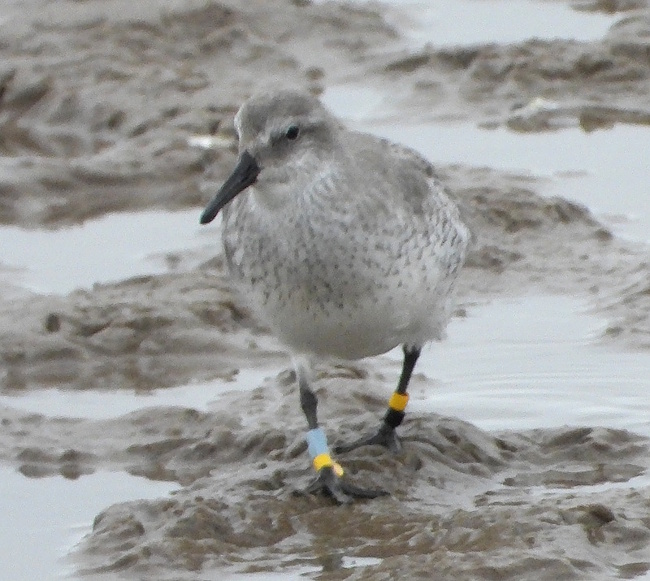
Y8YNPP
Ringed on the island of Griend, Dutch Waddensea, in September 2022.
It was seen back in the Waddensea in October 2023 and August 2024.
This bird has been a regular at Meols and Thurstaston every winter since being ringed.
It was recorded at both Thurstaston and Meols in the last week of October 2026.
The knots started to return in October and by the month-end we'd recorded 32 colour ringed birds.
Dunlin
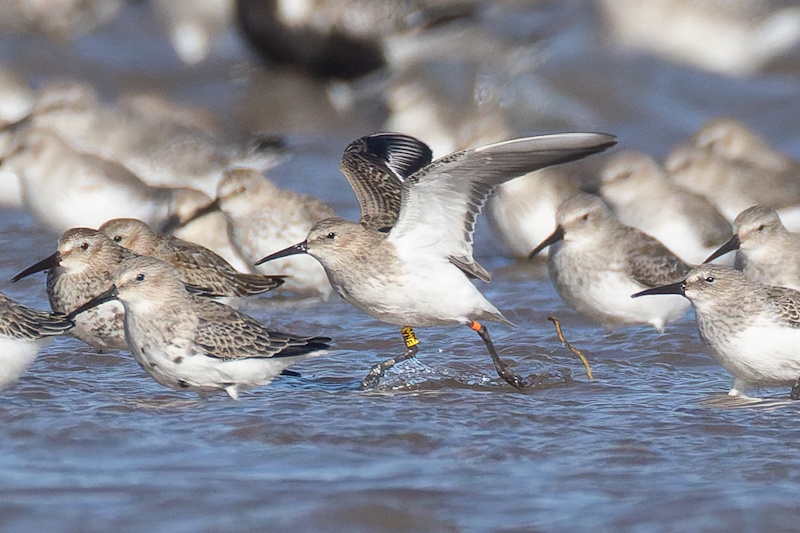
O - Y(YNE)
Ringed at Ynyslas (mouth of Dyfi Estuary) on 11/09/2026 as a juvenile.
Recorded at Hoylake 13/10/2026.
Another one ringed by the Mid-Wales
Ringing Group.
Grey Plovers
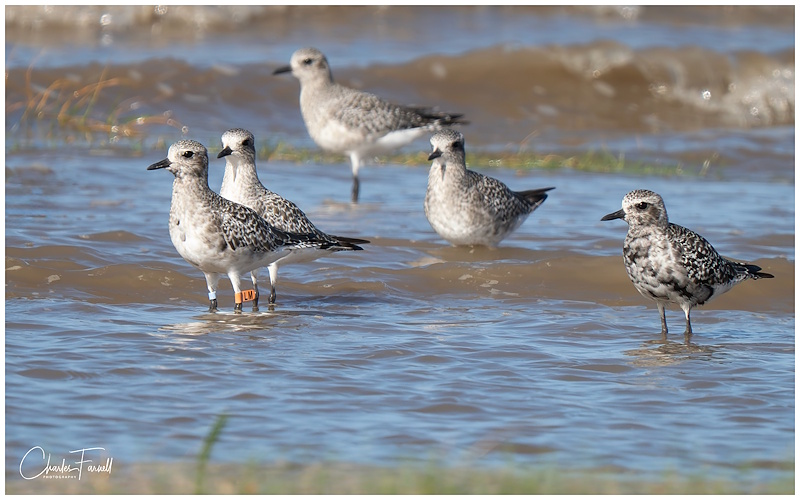
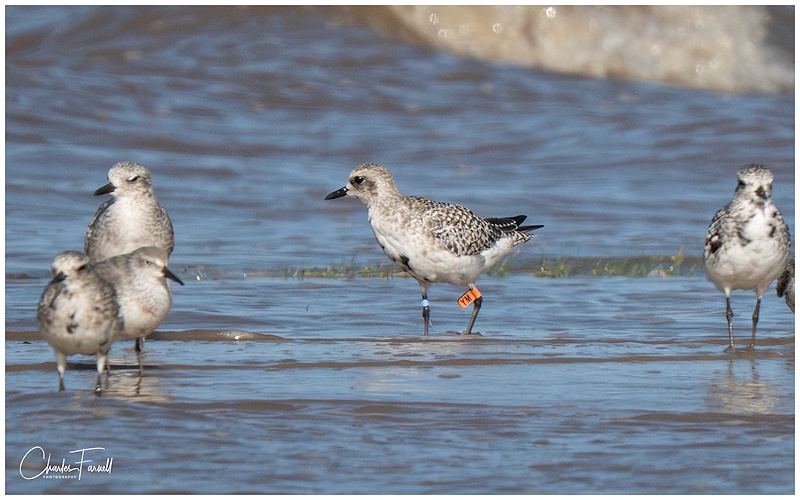
We recorded twelve Grey Plovers with orange flags during September and
October. These were all ringed over at Altcar (south Formby Beach)
during various catches between 2018 and 2023. Over the years we've seen
a total of 68 and these are recorded regularly between Ainsdale in the
north, down to Formby and Crosby, then at Meols and Hoylake and in the
Dee Estuary, mostly at West Kirby and Thurstaston. They are obviously
very site faithful with very few sightings away from that area
including a couple at Point of Ayr and a couple within the Mersey
Estuary. One was found dead in the Netherlands a couple of years ago.
Colour Rings were recorded by Richard
Smith, Stephen
Hinde, Tony Ormond, Sean O'Hara, Tim Kinch, Steve Williams, Joe Downing, Alan
Hitchmough, Mike Pollard, David
Thompson and Jack Rylance.
Richard Smith
October Bird News
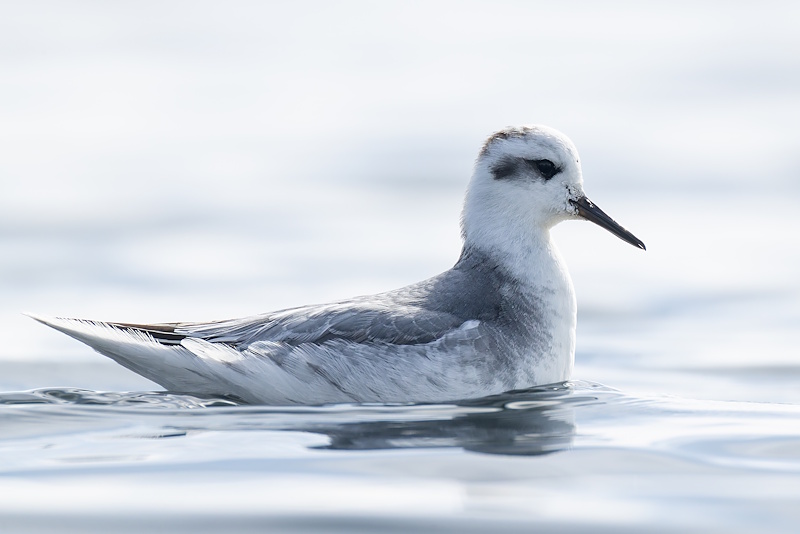
Sometimes Grey Phalaropes can linger at an inland site and this one was present on Shotwick Boating Lake from the 3rd to the 11th, giving great opportunities for photographs. They are more normally seen out to sea during strong winds and at least two were off north Wirral on the 25th during Storm Boelo.
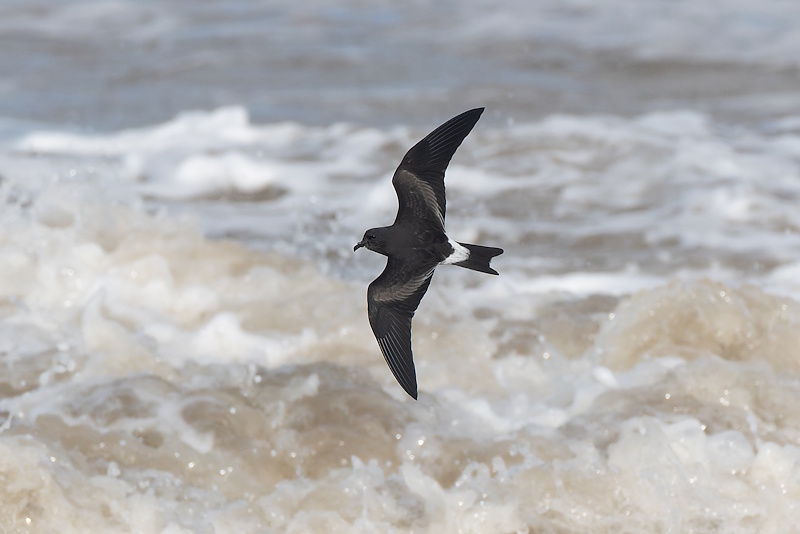
It continued to be a good autumn for Leach's Petrels
and strong westerlies on the 9th and 10th resulted in total of 22 past
Hilbre on the 10th with eight at New Brighton and six at Leasowe
Gunsite being good counts. Two Arctic Skuas and two Great Skuas were
also recorded from Hilbre on the 10th.
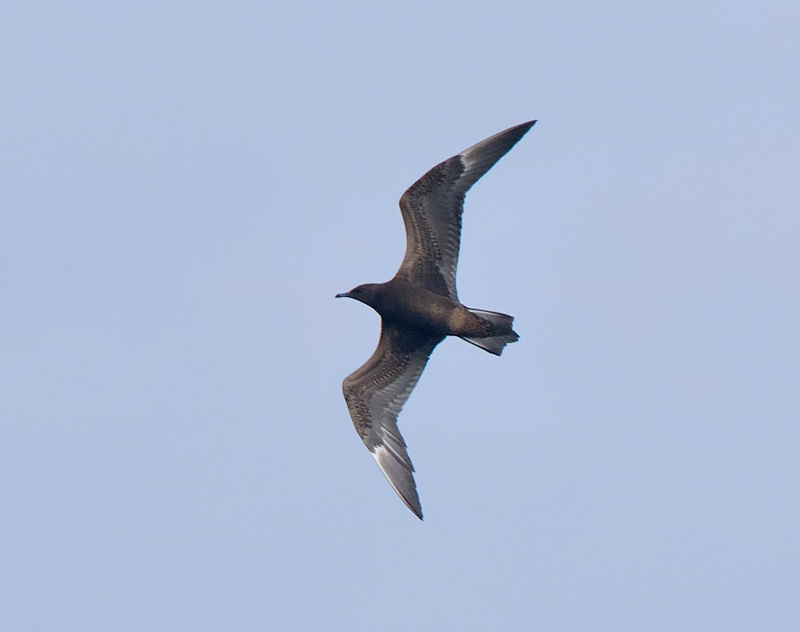
Storm Boelo struck on the 25th and enormous
waves were seen along the Liverpool Bay coast, making sea-watching
somewhat challenging. But an adult Pomarine Skua was seen well in the
River Mersey mouth, especially when it flew over the Marine Lake.
Single Leach's Petrels were at New Brighton, Wallasey Shore and Meols,
and at Hoylake there were a Great Skua, 3 Arctic Skuas, 15 Gannets and
150 Kittiwakes.
During calmer weather a late passage of Curlew
Sandpipers included 11 on the 1st and 12 on the 6th on Flint marsh. An
adult Curlew Sandpiper there was unexpected. A Glossy Ibis was on
Shotwick Fields on the 8th before moving to Burton Mere Wetlands a
couple of days later.
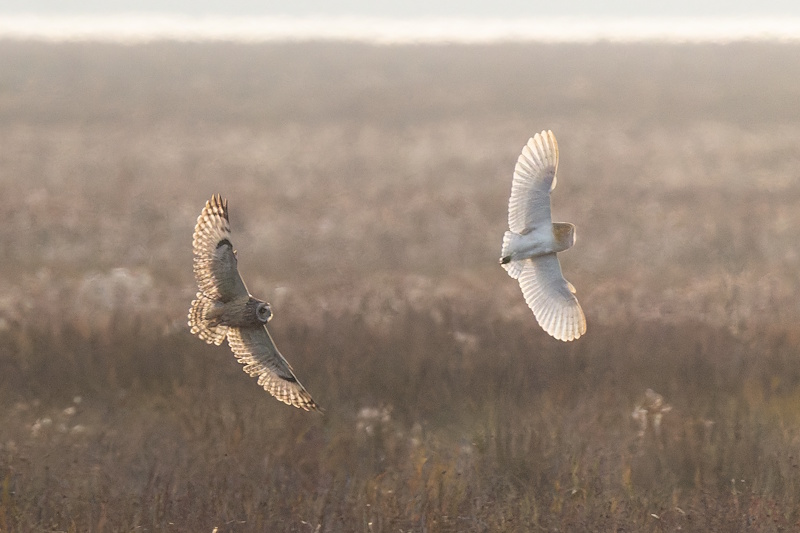
Away from the open sea there has been a bit of a
bird bonanza at Parkgate including great views of Short-eared Owls and
Barn Owls, as demonstrated in this great photo above. Early in the
month three Barn Owls were flying in the late afternoon whilst hundreds
of Pink-footed Geese flew into roost - wonderful! And by the month-end
there were great views of three Short-eared Owls, and six were flying
over Burton Marsh on the 22nd. Also at Parkgate there have been up to
16 Marsh Harriers and a couple of ringtail Hen Harriers, and good
numbers of ducks including a record 310 Shovelers and at least 1,500
Teal.
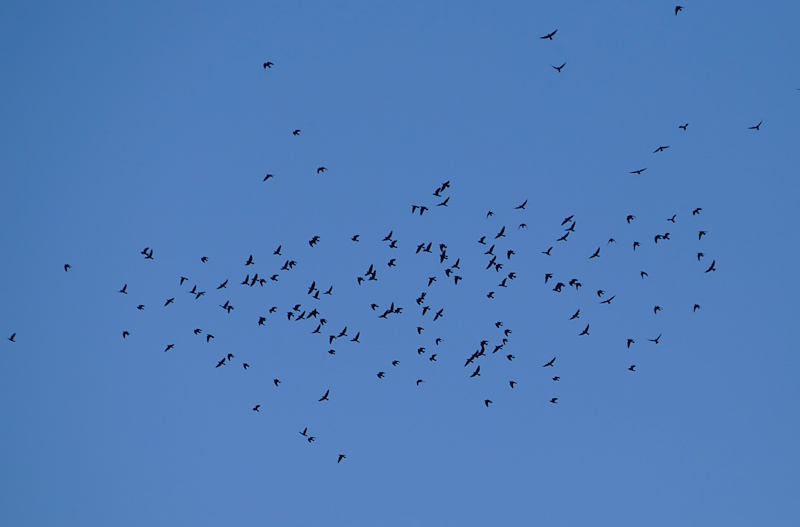
There wasn't an awful lot of visible migration but
the 18th produced 2,160 Jackdaws, 940 Redwings, 120 Fieldfares, 80
Skylarks and 384 Wood Pigeons over Lower Heswall/Little Neston.
What to expect in November
November should see the arrival of the first Snow Buntings of the winter, and there's always the possibility of one or two Lapland Buntings.
On the estuary the arrival of thousands of Knots and Dunlins from further east will be very noticeable, and expect flocks of 20,000 of each species at the usual high tide roosts. Also several hundred Sanderlings will be good to see, over-wintering numbers are increasing for this lovely wader.
Out to sea look out for rafts of Common Scoter and Great Crested Grebes, there could well be thousands of the former and hundreds of the latter off north Wirral, Hilbre and Point of Ayr. They are usually a long way out so you will definitely need a good 'scope.
There were good numbers of Short-eared Owls on the
marshes in October so lets hope they stay for the winter. Expect to see
plenty of Marsh Harriers and along with a few Hen Harriers on the
marshes.
Black Redstarts often turn up this month, usually a
single and usually somewhere near to the coast, they sometimes stay for
several days but can be elusive (see Black Redstart in Feb 2026 Newsletter).
November Highest
Tides (Liverpool Gladstone Dock):
25th 11.02hrs (GMT) 9.6m
26th 11.48hrs (GMT) 9.6m
27th 12.36hrs (GMT) 9.5m