Dee Estuary Birding
Monthly Newsletter...
April 2026
Newsletter
Red Knot in winter plumage don't all loook the same!
Peter Knight and Rose Maciewicz
Many of you will have looked at Knot (Calidris canutus islandica) in the Liverpool Bay area in winter and think that whilst they are exciting when in a murmuration, likely due to being pursued by a bird of prey, for the rest of the time they are just grey dumpy birds. However, although in the field Knot in non-breeding plumage all look much the same, we have found from close inspection of photographs that there are many subtle differences between individuals.
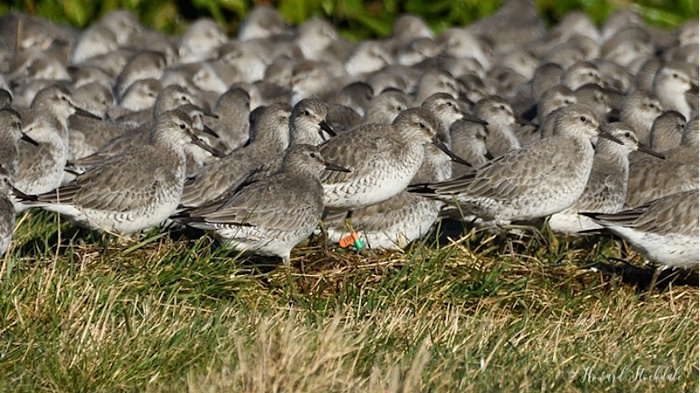
Why did we do this? In the course of the project
that we run that puts
coded orange flags on the tarsus of Knot, we are fortunate to receive
many sightings that are documented by photographs. Some of the photos
have part of the code illegible due to such factors as lighting, debris
covering the code, flag wear, and obstacles such as the legs of other
Knot or rocky terrain. Thus, there could be more than one code that
would be compatible with the image. Rather than discard all such
ambiguous records, we have looked at whether comparisons of plumage
with previously submitted images of the alternative codes would enable
us to find a match and eliminate alternatives.
How did we do this? We made a retrospective study of our library of
photographs of Knot that had been taken by observers to document codes
on flags. The library started in October 2017 and currently contains
over 5,000 photos. Knot in non-breeding plumage, which make up the vast
majority of photos, were evaluated for plumage features that varied
between individuals. In addition, we have over 100 individual Knot that
had photos taken of them in non-breeding plumage over multiple years.
We found useful variations in:
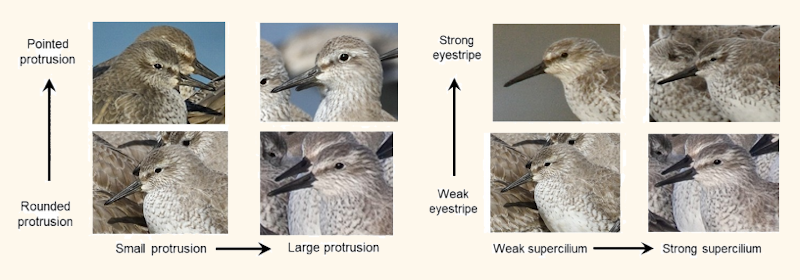
- the shape of the feathering at the base of the bill; the protrusion of feathers along the lower mandible can be rounded or pointed and small to large.
- the pattern around the face; with weak to strong dark eyestripe and weak to strong pale supercilium.
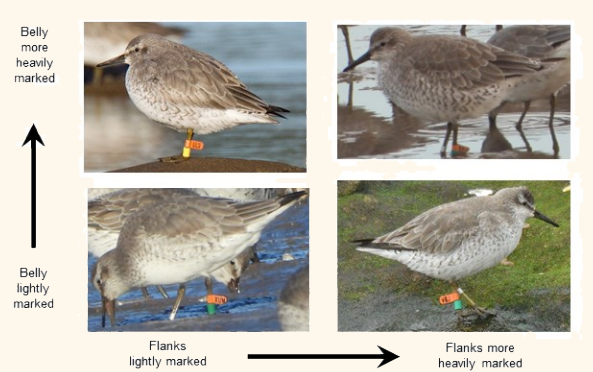
- the markings on the feathers of the flanks and belly. Not only is there a variable number of feathers with dark markings, but also variable size and shape of the markings. Photos: top left (Richard Somers Cocks); lower left (Richard Smith); upper right (Richard Smith); lower right (Howard Stockdale).
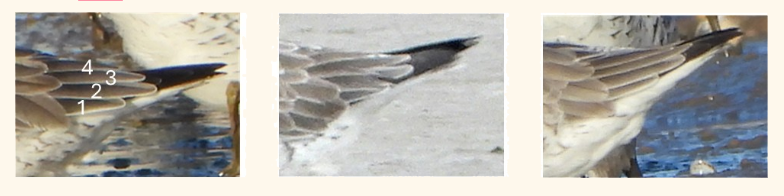
- the relative lengths of the tertial feathers. For instance, compared to the second tertial, the third tertial can be shorter (left), equal (centre), or longer (right).
We have found that the non-breeding plumage features are generally
bilaterally symmetrical. Importantly, they are very similar from year
to year, and a first-winter Knot shows similar patterning on its body
feathers as shown in its later years.
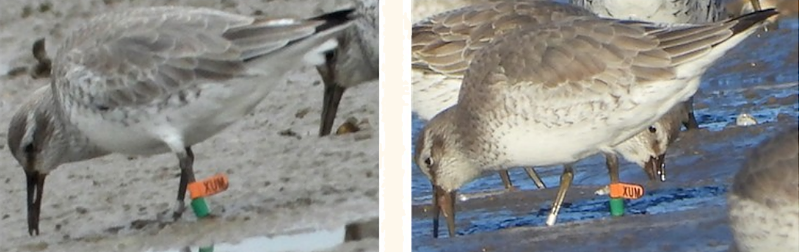
taken on the 6th January 2024 when the Knot was in its 4th winter (right). Photos Richard Smith.
These differences between individual Knot are not only scientifically
interesting, they also help the orange-flag project and observers in
the following way. Use of plumage features to identify ambiguous codes
maximises the sightings history of each colour-marked bird and thus
enables a more complete understanding of the survival, productivity,
migratory pattern and behaviour of Knot. Moreover, because observers
receive a history of any Knot that were identified in this way, they
are encouraged to send in further observations supported by photos,
which further builds our reference library. Everyone wins.
So, if you have photos of a Knot showing an indistinct or partial code,
send them to us as we may be able to identify the bird and send you its
history! We would encourage observers of such a bird to temporarily
keep all their photos in case one of them contains the vital clue.
This work raises some additional
questions.
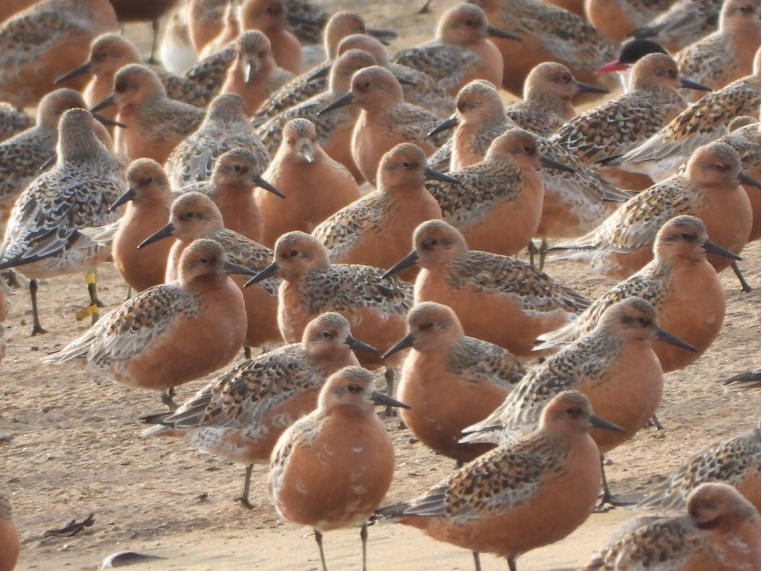
Do Knot in breeding plumage retain these plumage features? The photo
below shows Knot C. c. islandica
in breeding plumage, taken 19th May
2022 in Iceland prior to the Knot departing to the breeding grounds in
the Canadian Arctic. It shows that some features such as the patterning
along the flank feathers and to a lesser extent that of the undertail
coverts have been replaced by the plain, rufous breeding plumage that
shows little variation between birds. However, other variable features
of non-breeding plumage remain, such as the relative lengths of the
tertial feathers and the shape of the feathering at the base of the
bill. A new source of individual variation is the upperparts, where the
uniform and unvarying grey of non-breeding plumage has been replaced by
highly patterned mantle and scapular feathers that clearly do differ
between individuals.
Are variations in non-breeding plumage
observed in all subspecies of
Calidris canutus? There
are six subspecies of Knot that breed in
distinct regions of the high Arctic. Running eastwards from Canada
around the pole they are islandica,
canutus, piersmai, rogersi,
roselaari and finally rufa
which breeds to the south of islandica.
These six subspecies also have distinct wintering distributions and
migration routes. Furthermore, based on population genetics using
genome-wide SNP analysis, rogersi and roselaari have recently each been
split into two populations, and four closely-related pairs of
populations have been identified: canutus/piersmai, rufa/islandica,
roselaari W/E, and rogersi 1/2 (Conklin, et al. (2022) Molecular
Ecology, 31(7):2124-2139. https://doi.org/10.1111/mec.16379). In the
UK, the vast majority of Knot are islandica,
with canutus a rare
vagrant during its migrations between Siberia and West Africa and rufa
probably a transatlantic vagrant that has yet to be identified in the
UK.
Breeding plumage, along with biometrics, has traditionally been used to
separate and characterise Knot subspecies, and these differences
originate from genetic distinctions between the subspecies. So far,
little attention has been given as to whether non-breeding plumage also
differs between subspecies, but there is no reason why they should all
be the same. C.S. Roselaar (1983, Beaufortia, 33(7):97-109), after
study of museum specimens, states “Juveniles, immatures, adults in
non-breeding plumage, and often adults in worn breeding dress (July to
September) are usually indistinguishable to race by plumage, though
juvenile rufa averages paler
above than other subspecies”. We have
reviewed the photographs of all six subspecies in non-breeding plumage
that we could find on-line, and this showed that all of them have the
same features seen in our evaluation of C. c. islandica. No obvious
differences could be seen between the subspecies, but our evaluation
was limited by the small number of photos that we found of Knot of
known subspecies in non-breeding plumage. Nevertheless, it is clear
that plumage variation can be used to aid identification of individuals
of any subspecies of Knot.
Are there plumage differences in other
wader species? Photographs of
flocks of many wader species, or inspection of trays of museum
specimens show that individual variation is the norm, not the
exception. But such assemblies cannot address the question of whether
individual birds grow feathers with identical patterning year after
year. Breeding plumage Sanderling show a wide diversity of patterning
on the upperparts and yet individuals are known to have a consistent
pattern from year to year. It is thus likely that the individual
differences that we have been able to characterise in Knot by combining
colour-ringing and photography will turn out to be a generally useful
tool in studying birds. It is likely that the birds themselves, with
their acute vision, are well aware of these differences too and make
use of them, not just when selecting and recognising a mate but more
widely in their flocking behaviour.
We would like to thank all observers for their photographs of
colour-marked Knot.
This work was presented at the
International Wader Study Group (IWSG)
Annual Conference, 26 – 29 September 2025, Groningen,
Netherlands.
‘Plumage variation in Red Knot Calidris canutus aids colour-mark
identification’
RA Maciewicz and PJ Knight, poster presentation, abstract on page 40.
https://www.waderstudygroup.org/wp-content/uploads/2025/01/Poster-Abstracts-IWSG-conference-2025.pdf
Peter Knight and Rose Maciewicz
Colour Ring Report
Knots
To carry on
with the Knots theme I'll go into a bit of detail with some recent
sightings.
Thanks to a great bunch of fellow colour ring spotters we know that
many of the Liverpool Bay population of Knots disperse throughout the
coasts of the Irish Sea (and southern Ireland) over the winter, but
then return to the
Dee Estuary, Sefton Coast and Ribble Estuary in March before they fly
north-west across the Atlantic in early May. This dispersal and return
in March has been particularly noticeable this year and I use the
following selection of birds to illustrate this.
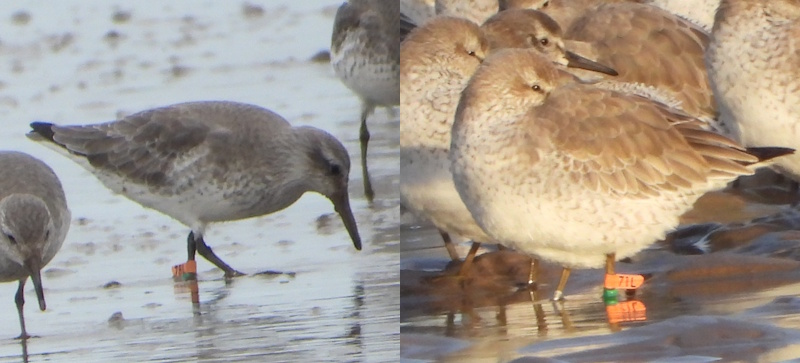
The extensive wetlands of Cork Harbour
and neighbouring inlets are probably the furthest west that our Knots
regularly go in the winter. Both these birds (orange flag 78L and 71L)
were at Cork
in January 2026. 78L returned first to Meols in early March, with both
birds at Thurstaston later in the month.
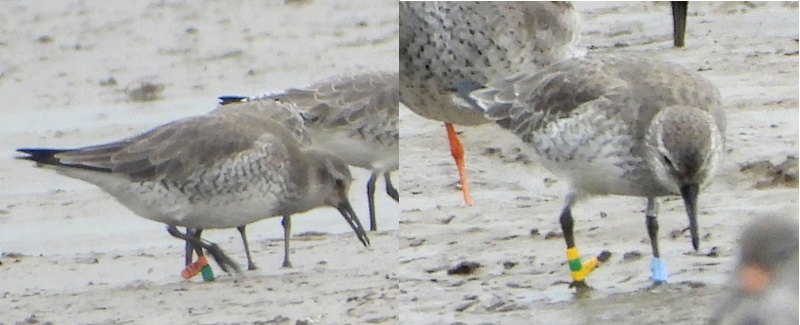
Dublin Bay has several thousand
Knots visiting each winter. Both orange flag 11P and the Dutch ringed
Knot (Y8PPYG)
were spotted near North Bull Island, on the north side of the bay, in
November 2025 and both were at Meols in the second week of March
2026.
They were recorded at Meols on consecutive days (9th and 10th) so it
seems likely they were moving around in the same flock.
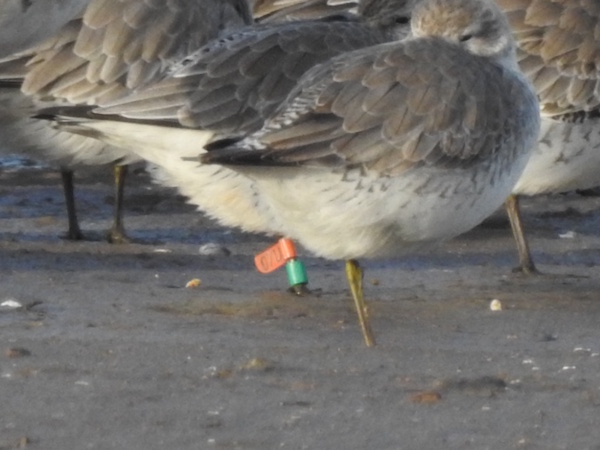
A lot of the Knots we see in the Dee Estuary end up in Dundalk Bay, and
further north on the Northern Ireland coast at Dundrum Bay and Strangford Lough.
This spring the only recorded Knot which has returned from there is
07U. For the third winter running it was recorded in Strangford
Lough and it was at WWT Castle Espie in November 2025 before returning
to Thurstaston in mid-March.
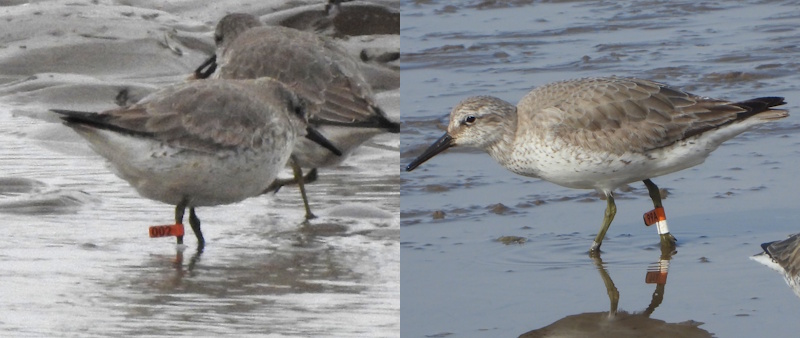
These
two, Orange flags 002 and 99A, are 2CY birds, i.e. hatched in 2025.
They were caught and ringed in January and February this year at Ynyslas
at the mouth of the Dyfi estuary (Cardigan Bay). There are no sizable
flocks of over-wintering Knots in that area and we think these young
birds were probably moving around with flocks of Dunlin, as young knot
often do. Anyway, they both managed to find their way to the Dee
Estuary in March with 002 at Thurstaston and 99A at Meols.
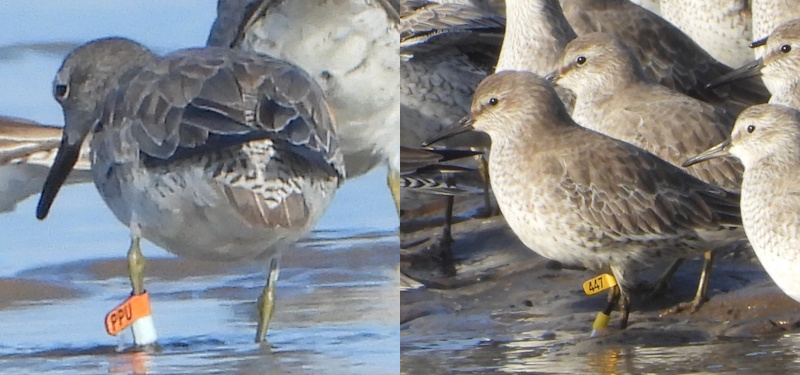
There are
quite extensive mudflats at the eastern end of the Menai Straits,
particularly between Bangor Harbour and Llanfairfechan, and several
hundred Knots are present there through the winter. These two (Orange
flag PPU ringed at Bangor in 2024, Yellow flag 447 ringed in
Iceland in 2025) were recorded in Bangor
Harbour in February 2026, and
both were at Thurstaston in March. Additionally, 447 was at Heysham
(Morecambe Bay) in November 2025 and at Burton Mere Wetlands in late
March 2026.
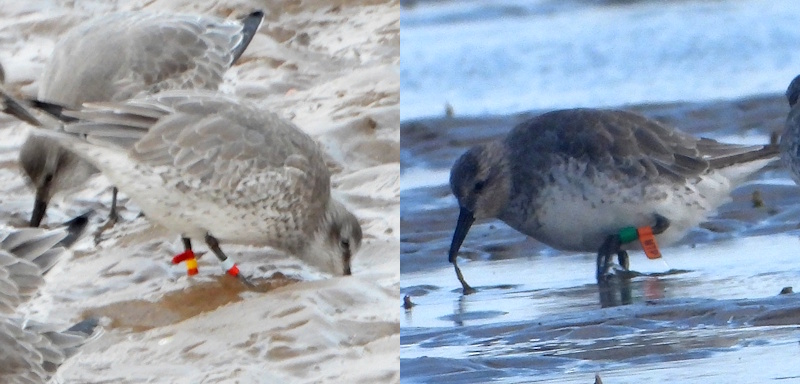
Morecambe Bay has similar numbers of Knots as the
Dee Estuary and no doubt there is much interchange between the two
sites. Nearly all the records we get for ringed birds come from Heysham
where there is both a roost site and mudflats for them to feed on. The
Dutch ringed bird (R3YRPR) was recorded at both Meols and Thurstaston
in November and December 2025 brfore flying to Heysham were it spent
January and February, it returned to Thurstaston in March. Orange flag
MTP was recorded at Heysham in November 2025 and at both Thurstaston
and Formby in the third week of March 2026.
Little Gull
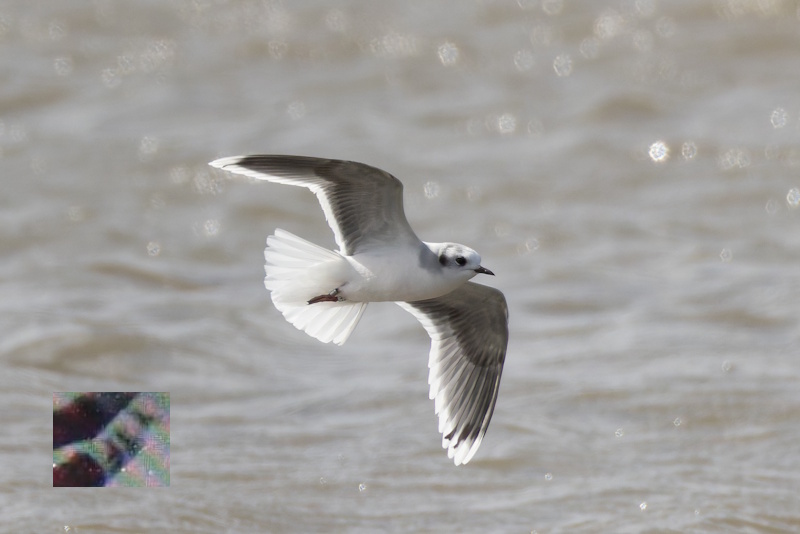
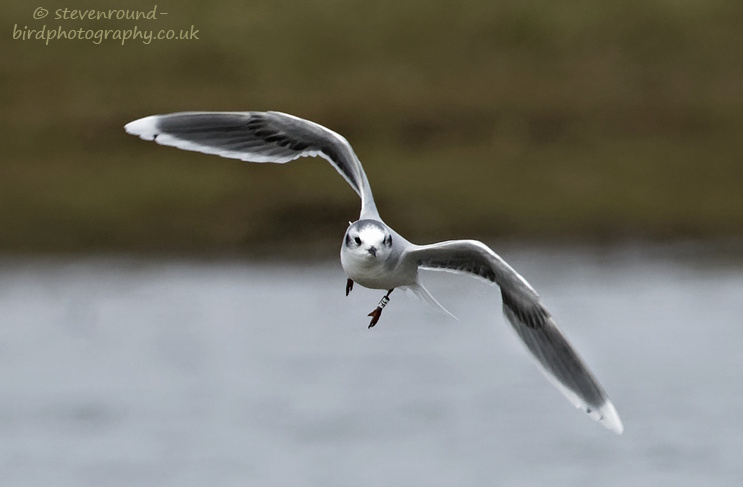
White (1F)
An
excellent record! It was David King who first spotted the White ring on
this Little Gull on the 30th, and Joe Downing managed to get a good
flight shot with the ring showing, and the next day Steve Round also
got a good photo showing the ring.
It was ringed on 10/07/2024 in Finland about 112 Km north-east of the
northern shore of the Baltic Sea, just north of Rovaniemi, Lappi.
Black-tailed Godwit
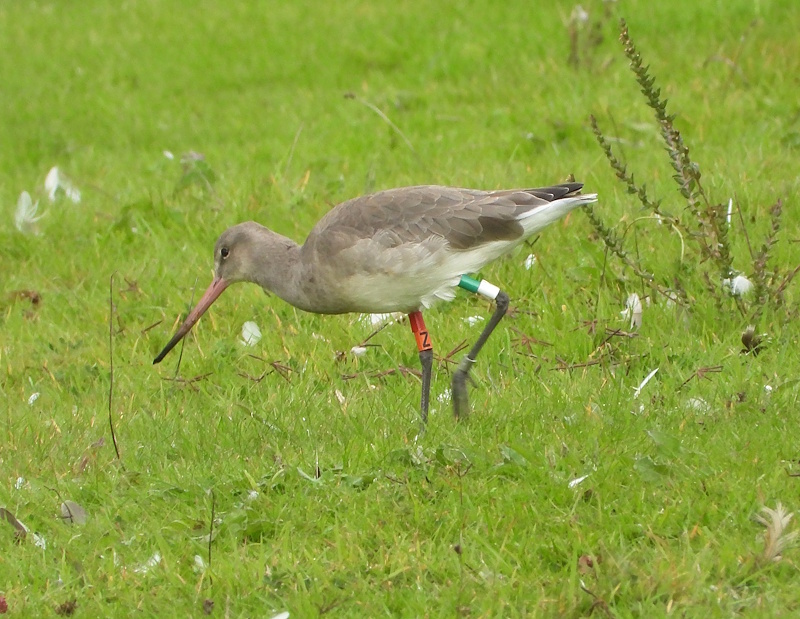
GW-RZ
Ringed at Utey, south Iceland, on 12/06/2025, as an adult.
It was one of the first birds to arrive back from Iceland at Caldy
Wildfowl Collection on 30/06/2025 and was there until late September
2025.
It's always good to get records from Portugal at the southern end of
the godwits range, and this one was on the Vouga Estuary (just south of
Porto) in January 2026.
It returned to Caldy Wildfowl Collection on the third week of March
2026.
Stonechat
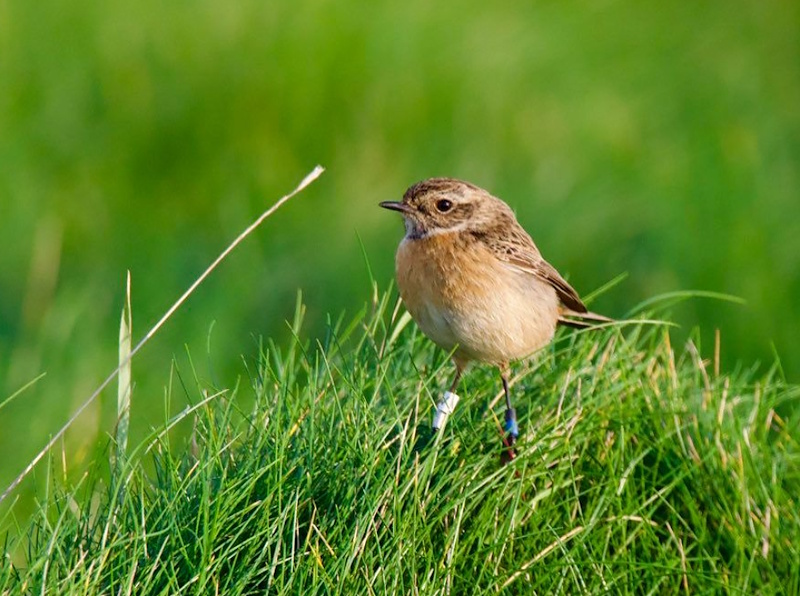
Black over blue -
White (V)
We see quite a few Stonechats here, particularly in spring when they
are moving north, but this is the first one recorded with colour rings
- a great find by Hilbre Bird Observatory.
It was ringed on the island of Mull in August 2025 before being found
on Hilbre on 04/03/2026. This is the first re-sighting of the 26
Stonechats ringed on Mull during 2025.
Colour Rings were recorded by Richard
Smith, Stephen
Hinde, Sean O'Hara, Angela Graham, Paul Ralston, Steve Williams (Hilbre
Bird Observatory), Tim Kinch, Joe Downing, David King, Steve Round and Alex Jones.
Richard Smith
March Bird News
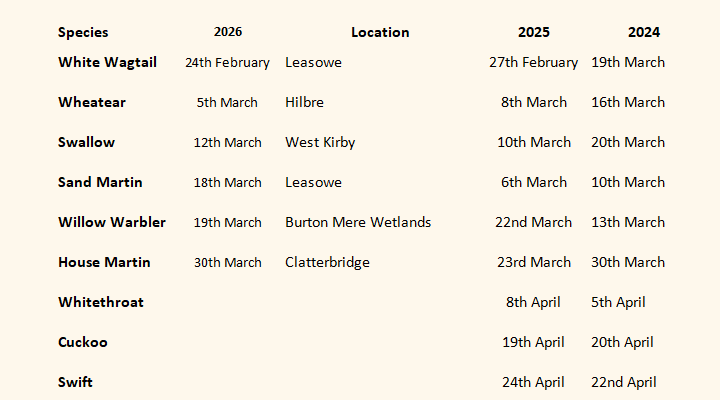
The spring migration started early with a White
Wagtail in February, but the first Sand Martin was the latest for at
least 10 years, and I don't remember a year when the first Swallow
arrived before the first Sand Martin. The first Whitethroat, Cuckoo and
Swift will arrive in April, send me an email
 if you see an
early arrival and, if it's the first one, I'll put it in the table
below:
if you see an
early arrival and, if it's the first one, I'll put it in the table
below:
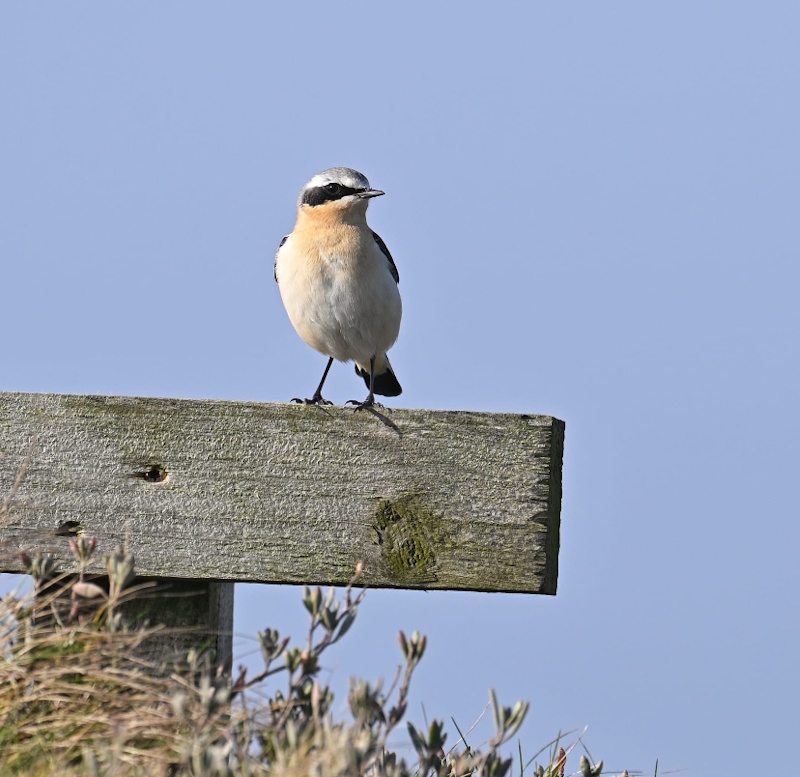
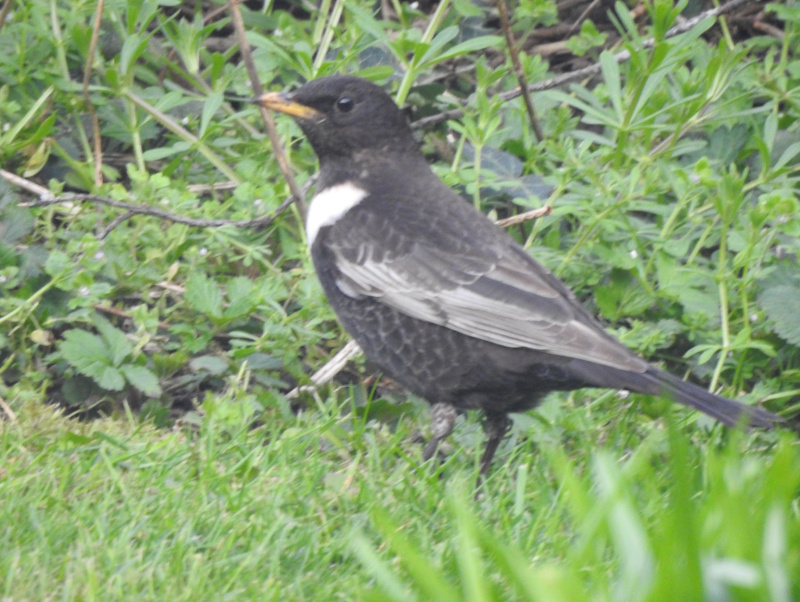
But the above species were certainly not the
only ones on the move and Steve Hinde got a big surprise when a Ring
Ouzel turned up in his back garden on the 20th. These March records are
reckoned to be British breeders, with Scandinavian breeders not coming
through here until April.
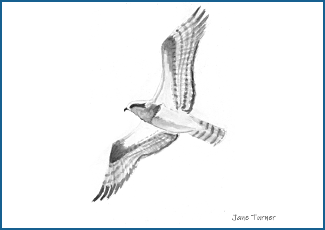
We had our first Osprey over on the 29th and a
pair of Garganey arrived at Burton Mere Wetlands the following day. At
the latter site the first Avocets arrived in February but they had
reached an impressive 95 by March 4th.
Out to sea Little Gulls started to come through on
the 3rd with six off Hoylake, max count from Hilbre was 31 on the 15th.
That same day also saw a good passage of Gannets, with 165, and also
220 Common Gulls. The first Sandwich Tern of the year flew past Hilbre
on the 21st. During strong westerly winds a Manx Shearwater was spotted
at New Brighton on the 25th.
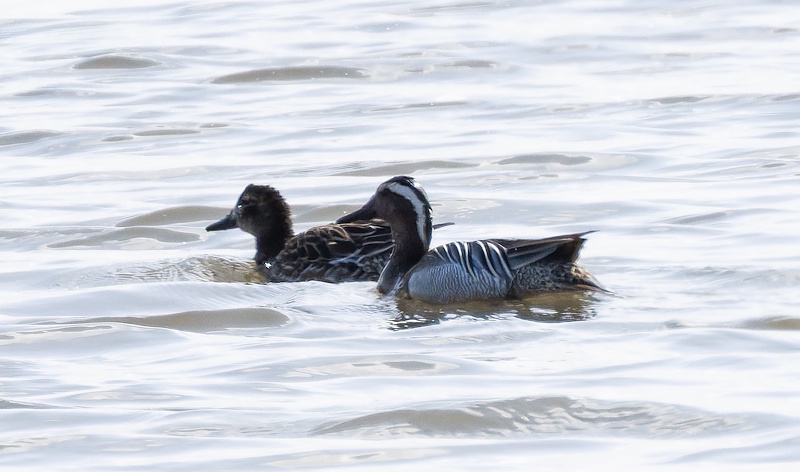
Two Common Cranes were in the area, they flew over Burton Mere Wetlands
on the 4th and were seen again from Heswall on the 18th flying up the
estuary.
The flock of at least 40 Russian White-fronted Geese
were still present in the Burton Mere Wetlands area early in the month.
I'm told by our WeBS Coordinator (Colin Wells) there was a total of 75
on the Dee Estuary for the February WeBS count, which I believe is the
highest count since at least the 1960s. Interestingly, even higher
numbers were on the Dee flood meadows upstream of Chester with a peak
of 215 in February, and there were other flocks in Cheshire probably
making a total of around 350 - 400, such numbers haven't been seen in
Cheshire since the 1950s.
A drake Green-winged Teal was at Parkgate most of
the month, with a second there on the 11th. Perhaps it was this second
bird that turned up in the channel at Heswall on the 17th and 18th, a
spring Green-winged Teal has been recorded here on four of the past
seven years - likely to be the same bird.
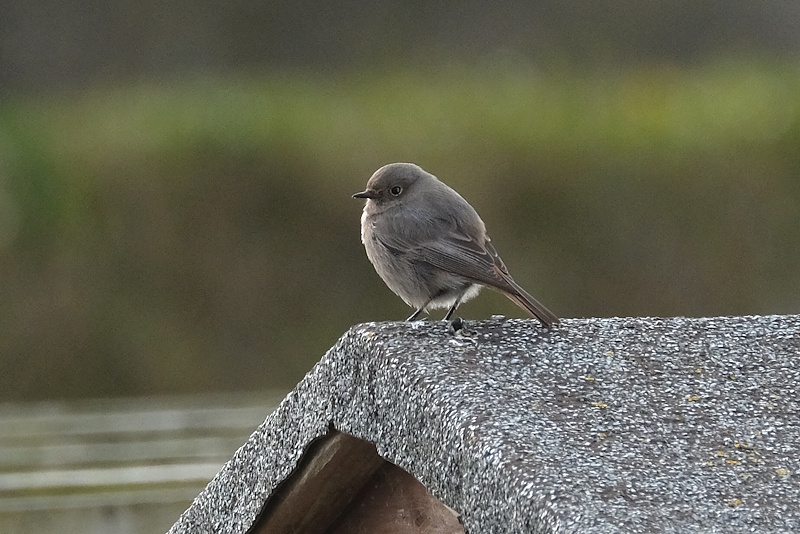
A Black Redstart (female 'type') was in the Dove
Point area at Meols most of the month, first seen on the 5th. As they
often are it was somewhat elusive, often hanging around the stables
behind the Coastguard station.
What to expect in April
April is when the spring migration really gets underway, especially from mid-April onwards. I can do no better than quote from my article "The Spring Migration" written in April 2024:
The Spring Migration
starts around early March and
can still be underway in early June, but it no doubt peaks in
the second half of April and into early May. It can be an
exciting and magical time
- waking up on a spring morning to find Wheatears in every field and
Willow Warblers in every bush. It's about far more than just those two
species, of course, and it's exciting because we see species rarely
recorded here at other times of the year. No spring is the same and we
will remember days when the beach is covered in White Wagtails, or four
or
five Ring Ouzels in one field, or hearing dozens of Whimbrels calling
on
the shore, or a mega rarity turns up, or.......
To read the full article it is in my April
2024 Newsletter.
As well as the species mentioned above (and in the article) look out for Whinchats, the first ones usually arriving by mid-month. Ospreys will be passing through, sometimes stopping a few hours to catch a fish or two. Tern numbers will increase and we can get some good size flocks of Sandwich Terns off Hilbre, and any day with a good westerly wind should result in a good passage of Gannets off-shore. April is also the month when the Pink-footed Geese leave us, visit the estuary early morning and you may well see flocks of several hundred heading north.
Waders will be moulting into breeding plumage with
Knots, Bar-tailed Godwits and Black-tailed Godwits looking stunning in
their 'red' plumage by the end of the month.
April Highest
Tides (Liverpool Gladstone Dock):
17th 11.44hrs (BST) 9.6m
18th 12.24hrs (BST) 9.8m
19th 13.06hrs (BST) 9.8m
20th 13.51hrs (BST) 9.6m